ARTFUL MATHS
  • Home
  • Resources
    • Mathematical Art Lessons
    • Classroom Display Ideas
  • Origami
    • Origami Clubs
    • Origami in Lessons
    • Origami Gallery
  • Puzzle Games
  • Blog
  • About
  • Contact Me

More Origami Christmas Decorations: Outer Space

18/11/2017

0 Comments

 
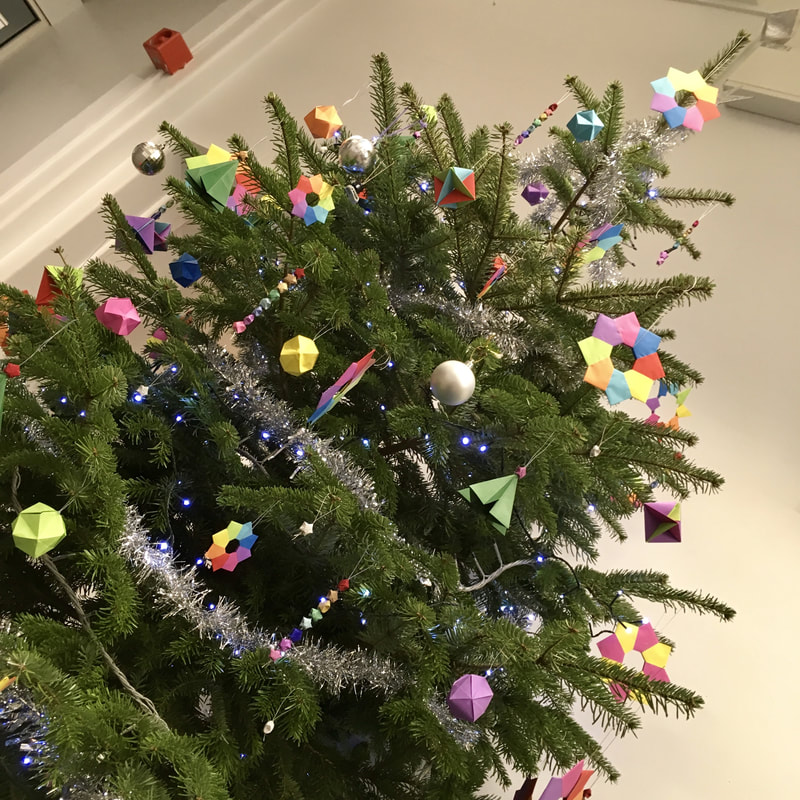
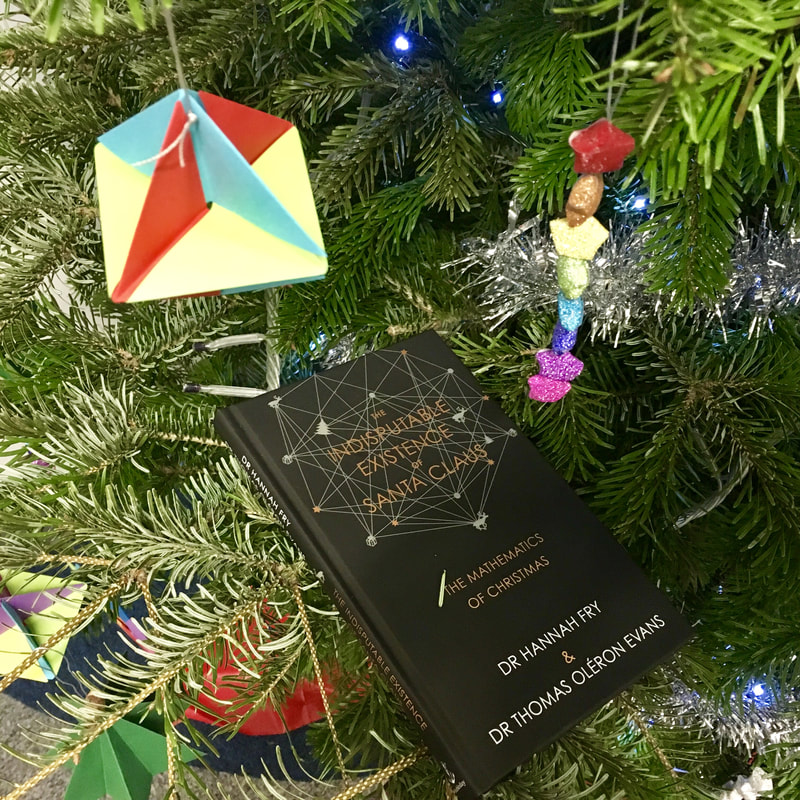
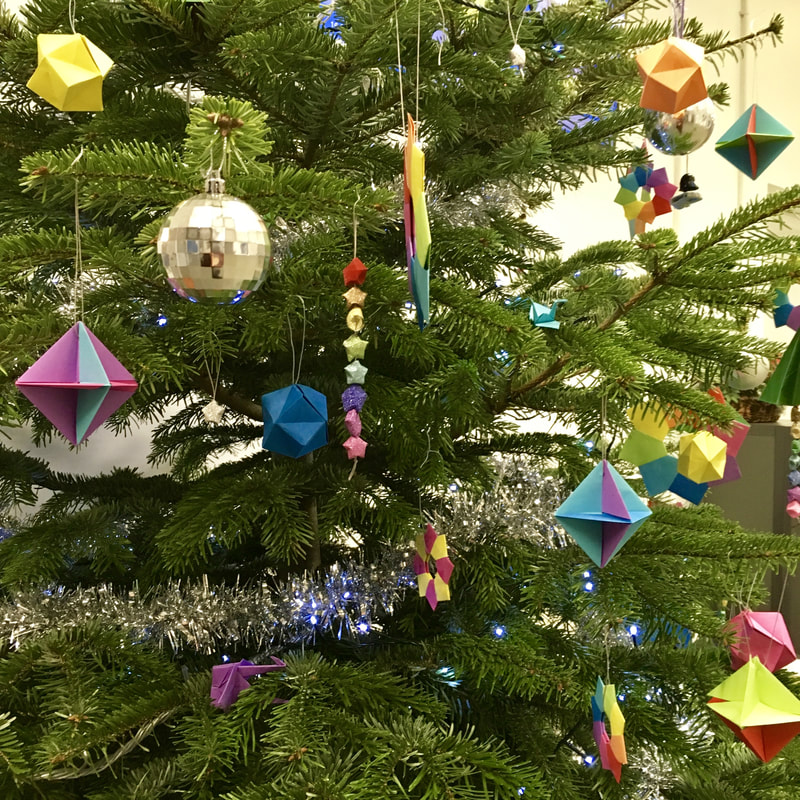
Last year my sixth form origami club had great fun decorating the sixth form Christmas tree with a colourful rainbow theme. The instructions for most of the origami decorations we made can be found in this blog post: Origami Christmas Decorations. I’m sure you’ll agree the tree turned out beautifully, and it was, in fact, award winning! We won one of Dr Hannah Fry’s prizes for her mathematical Christmas decorations competition on Twitter - a copy of her book “The Indisputable Existence of Santa Claus".
Picture
Picture
Picture
This year the challenge is to match last year’s success - a tall order! We’ve come up with an idea for an ‘outer space’ theme: stars and moons and planets and rockets, in golds and silvers and midnight blues. And one enthusiastic and talented student, Amber, has proposed folding a giant rocket, of her own design, for the top of the tree!
As I’ve being doing a fair amount of research into suitable folds, I thought I’d share the results here, so that others can decorate their own ‘outer space’ trees. Perfect if you’ve budding astronauts at home!

Stars

There are hundreds of beautiful origami star designs; here's a small selection of relatively straight-forward, 5-pointed, Christmassy ones.

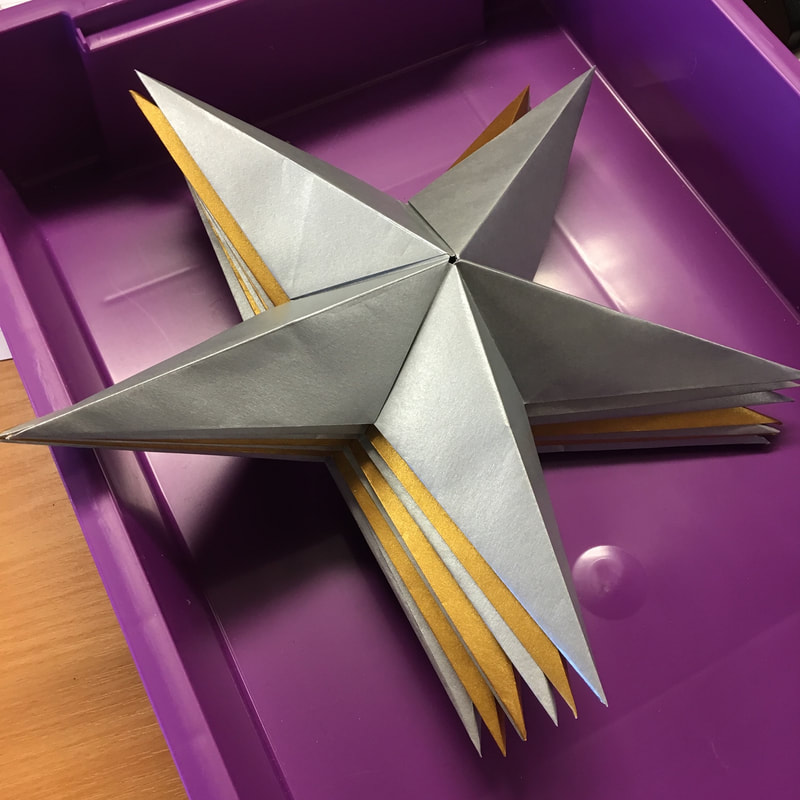
1.        Modular 5-pointed Star by Tomoko Fuse and Nick Robinson (photo below)
Photo instructions:
http://www.origami-instructions.com/easy-modular-5-pointed-star.html
Diagram: http://www.nickrobinson.info/origami/diagrams/modstar.htm

2.        5-Pointed Star (from a pentagon; see video):
Diagram:
http://www.origami-resource-center.com/support-files/5pointedstar.pdf
Video: http://www.homemade-gifts-made-easy.com/5-pointed-origami-star.html
 
3.        Modular Gift Star (‘dollar star’):
Diagram:
http://mvg-ori.nl/ori-l/models/ornament/moneystar.pdf
Video: https://www.youtube.com/watch?v=cj3dgRJ3mUs
Picture
Picture

Moons

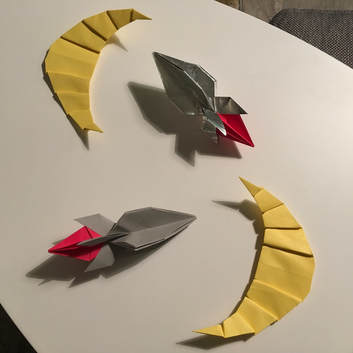
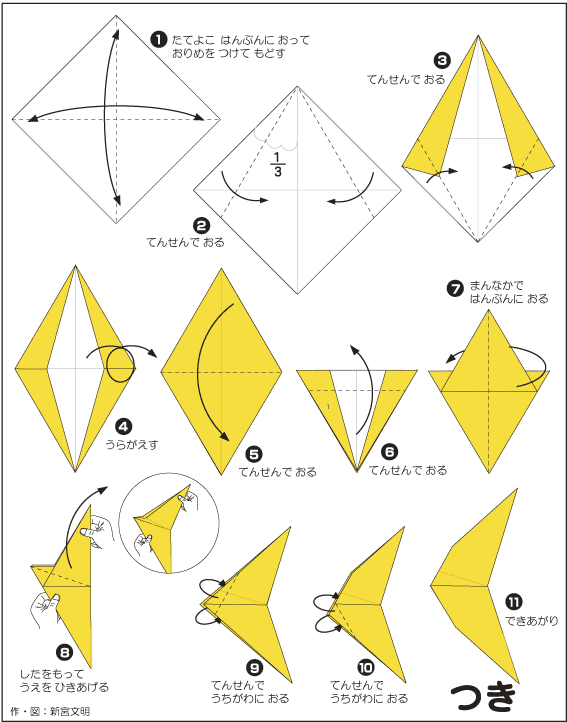
A couple of crescent moons. The first is the simpler. For the second, I decided to omit the 'man in the moon' face, and instead just tucked the redundant flap back inside the model.

1.        Moon by Fumiaki Shingu:
Diagram:
http://1.bp.blogspot.com/-sroyG0j7Lp0/T3NoZY9LUJI/AAAAAAAAAWo/y7r_W62MLhc/s1600/moon+instruct.gif
Video: https://www.youtube.com/watch?v=zq2D3TorvJw

2.        Man in the Moon (photo above (modified version)):
Video:
https://www.youtube.com/watch?time_continue=20&v=hZ4Rs8mw5pI

Rockets

Gotta have some rockets!

1.        Easy Origami Rocket by Paper Kawaii
Video:
https://www.youtube.com/watch?v=YEfK-xifwVA

2.        Origami Rocket Ship by Paper Kawaii
Video:
https://www.youtube.com/watch?v=i1ksI-OzlZ4

Planets

Trickier to find, as curved surfaces are difficult. I've opted for a couple of vaguely ball-like shapes.

1.        Stellated Octahedron by Sam Cuilla:
Diagram:
http://britton.disted.camosun.bc.ca/stellated_octahedron.pdf
Video: https://www.youtube.com/watch?v=dwUW5QOY_ZU  

2.        Modular origami ball by Tomoko Fuse:
Video:
https://www.youtube.com/watch?v=uISX5jP4iy0 

Little green alien!

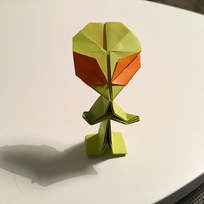
What a find! We've absolutely got to include a few of these little chaps :)

Origami Alien by Riki Saito:
Video:
https://www.youtube.com/watch?v=_gQurMRSjzY

I'll update the post with a photo of our tree when it is complete. Happy festive folding!
Picture
0 Comments

HeArtful Maths

5/2/2017

0 Comments

 
A selection of creative Valentine's Day maths activities.

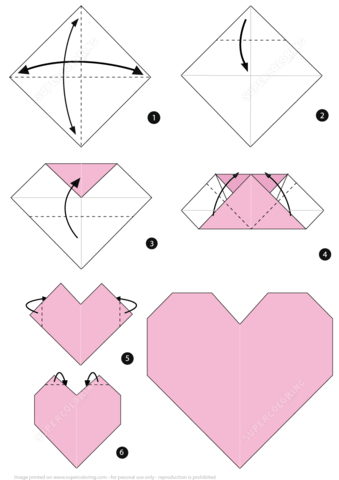
Easy origami heart

This is a straightforward fold that makes a really neat little paper heart. Either print out these instructions from www.supercoloring.com and let your students tackle it independently, or use one of the many videos on Youtube.  This one is particularly clearly demonstrated.

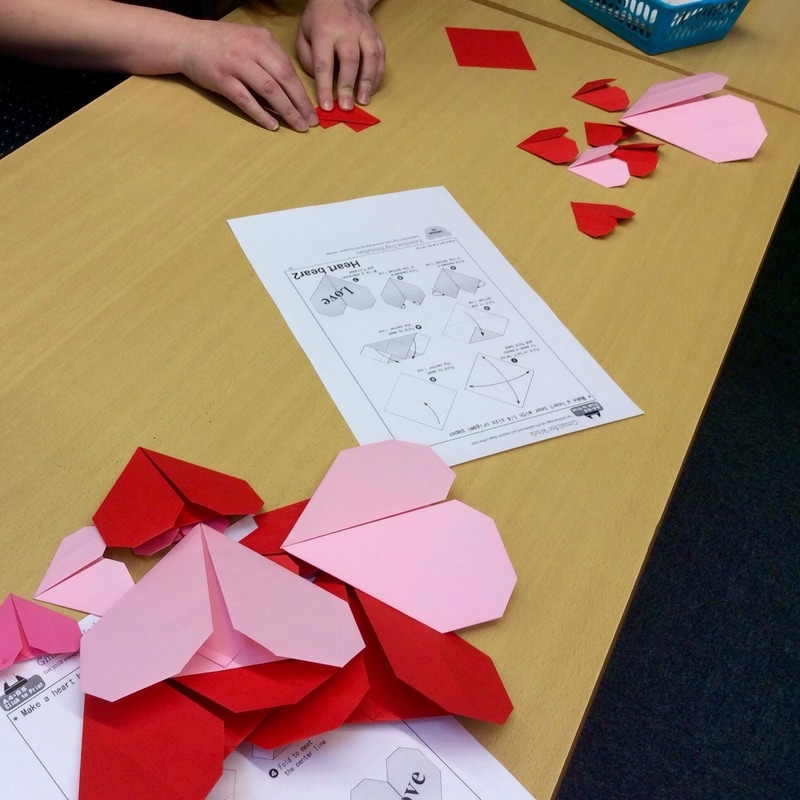
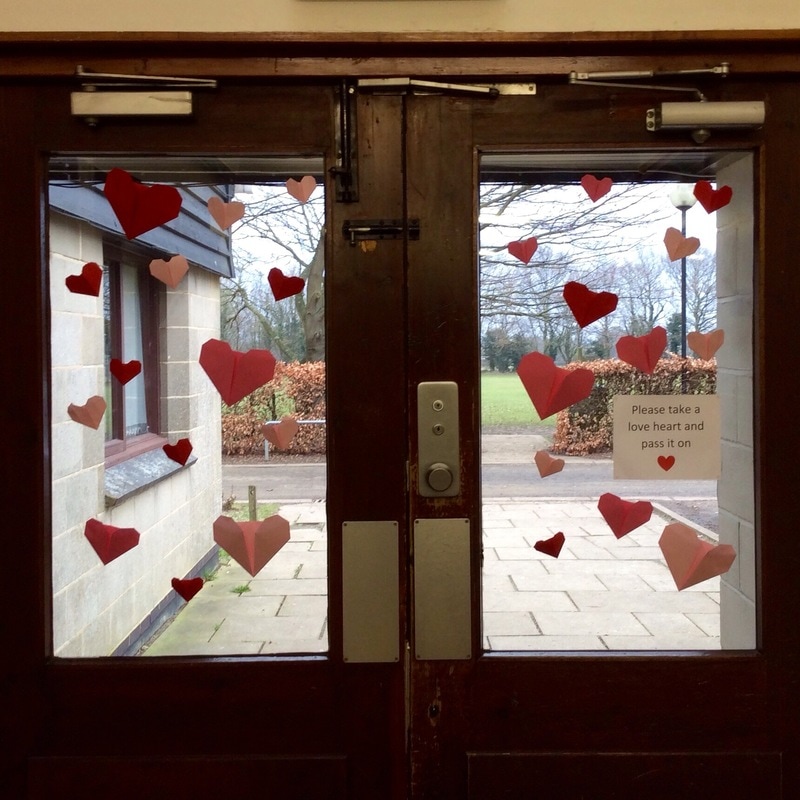
Students can open up their hearts and write messages on the inside.  Alternatively you can spread the love around by doing some 'origami bombing'.  This goes down a treat!


Picture
Picture
Picture
A nice extension to this activity is to ask students to find the area of their heart as a proportion of the original square it was folded from.

Drawing a Cardioid

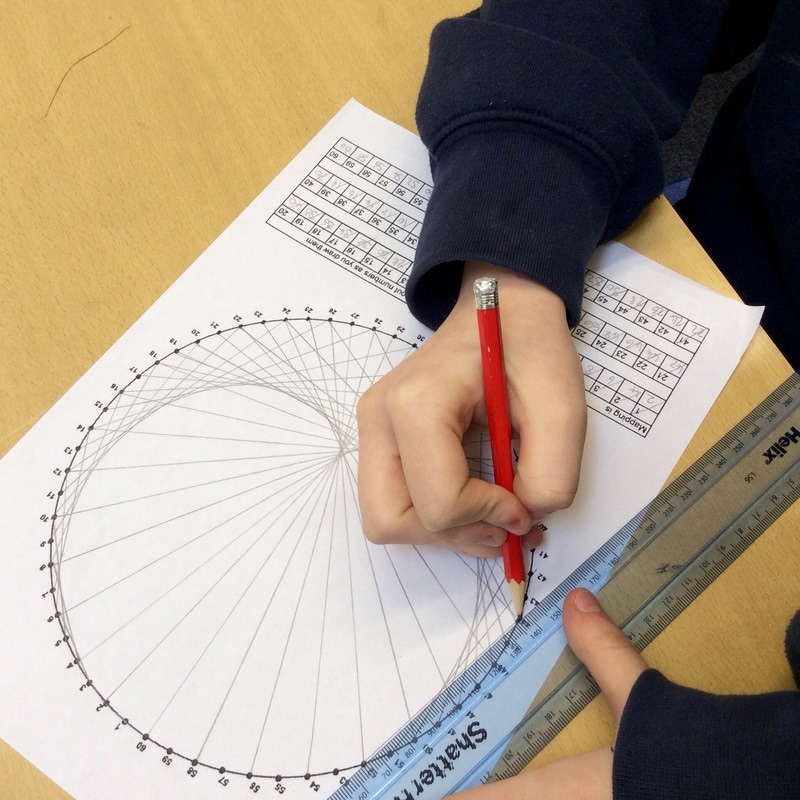
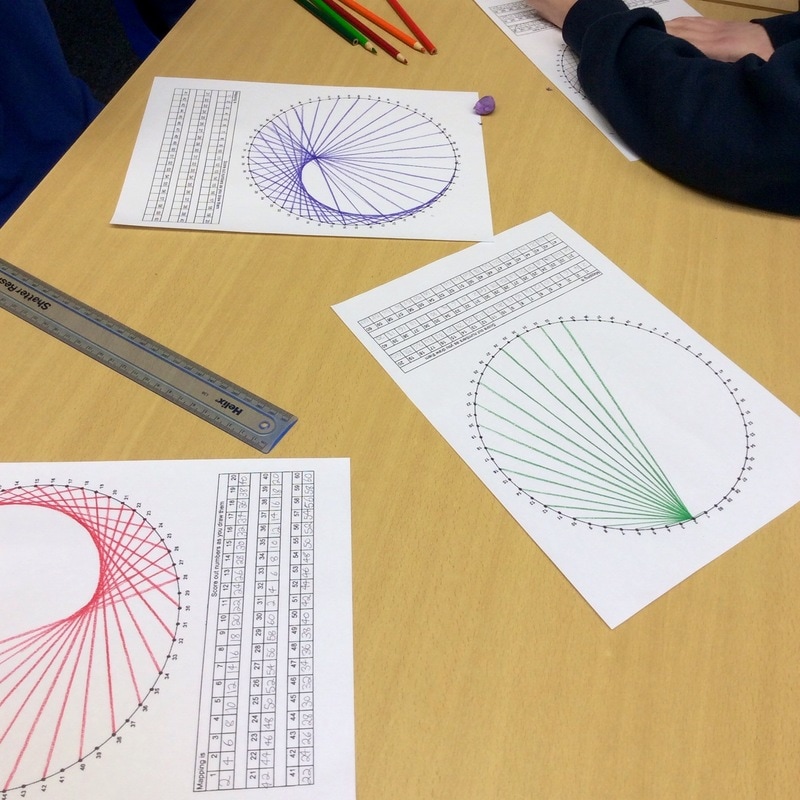
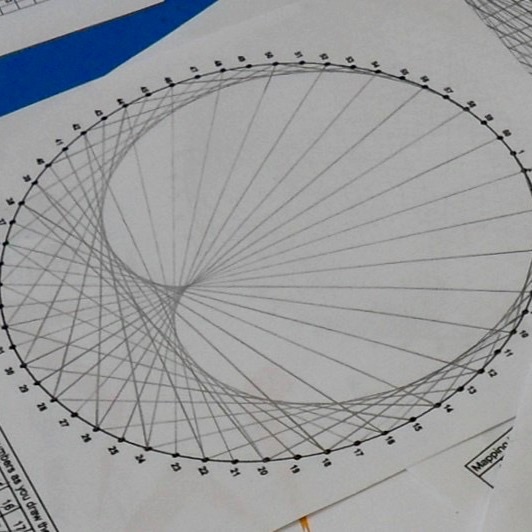
This lesson is featured on my Mathematical Art Lessons page.  It is a 'curve stitching' style lesson that looks at the occurrence of these intriguing functions in the world around us and introduces the idea of modulo arithmetic. Credit and thanks are due to K Rybarczyk of Knightswood Secondary School for the printable 60 point circle templates.

​Resources provided: a presentation which introduces the cardioid, shows examples in different contexts, and demonstrates the drawing procedure; printable template. Resources needed: pencils, rulers, erasers, coloured pencils or pens (optional).

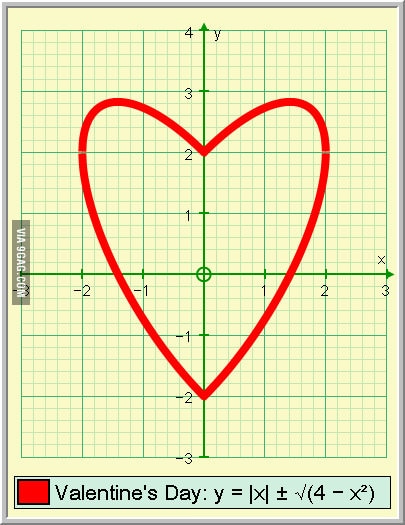
Plotting parametric hearts

Older students can practise plotting parametric or polar functions to produce a heart-shaped graph.  This can then be cut out and stuck onto card to make a truly geeky Valentine's card :) There is a good selection to choose from on Wolfram Mathworld and some alternatives at Owlcation.  And this one from 9gag uses the modulus function:
Picture

Slotted paper heart globe

Martin Holtham (@GHSMaths) introduced me to this lovely 'paper heart globe' icosahedron-type construction from www.extremepapercrafting.com (what a great name for a website!), originally shared by John Golden (@mathhombre) on Twitter. Full step-by-step instructions and a printable template are available on the website, along with a link to the following assembly video by @dutchpapergirl:
Happy Valentine's Day!
0 Comments

Folding Christmas Fractals

3/12/2016

2 Comments

 
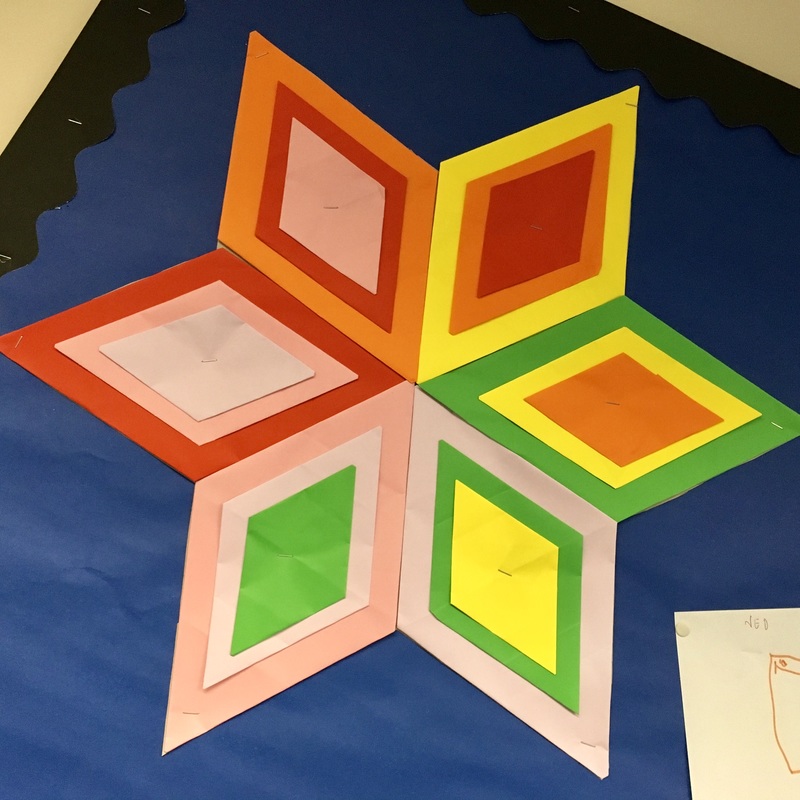
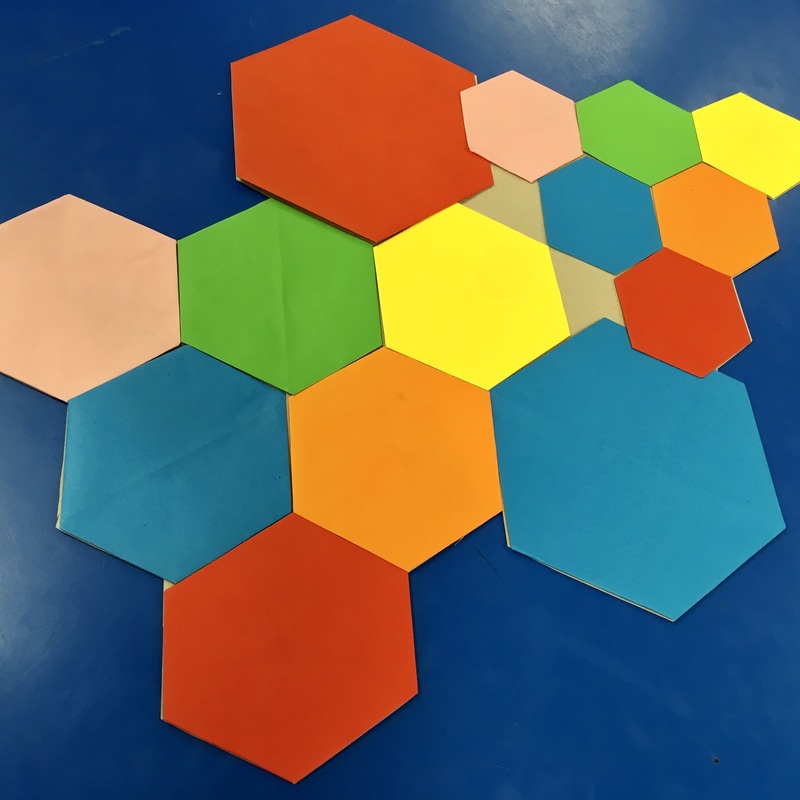
I've just finished a five week stint running our school's Y7 and Y8 STEM Club - and what fun it's been!  I chose the theme of 'fractallations' - a fractal-tessellation hybrid that would allow me to include lots of my favourite things, including, you guessed it, some paper folding  :)
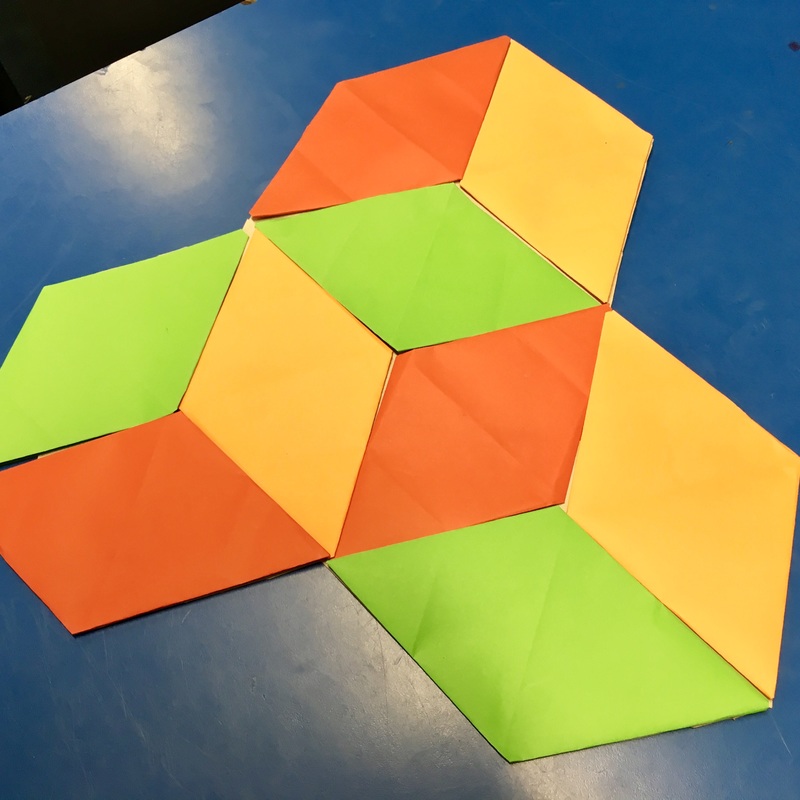
We started by exploring what characterises a 'fractal' pattern (in visual terms) and then investigated and drew Sierpinski Triangles using this excellent resource from the STEM Learning centre. Then, in week 2, we looked at tessellations, and learnt how to fold paper polygons with which to create some tessellations of our own (below).  For this I used my 'Patchwork Paper Patterns' presentation containing Liz Meenan's instructions - available on the Mathematical Art Lessons page. 
Picture
Picture
Picture
With the basics now in hand, we could start folding Christmas fractals...

Koch Snowflakes

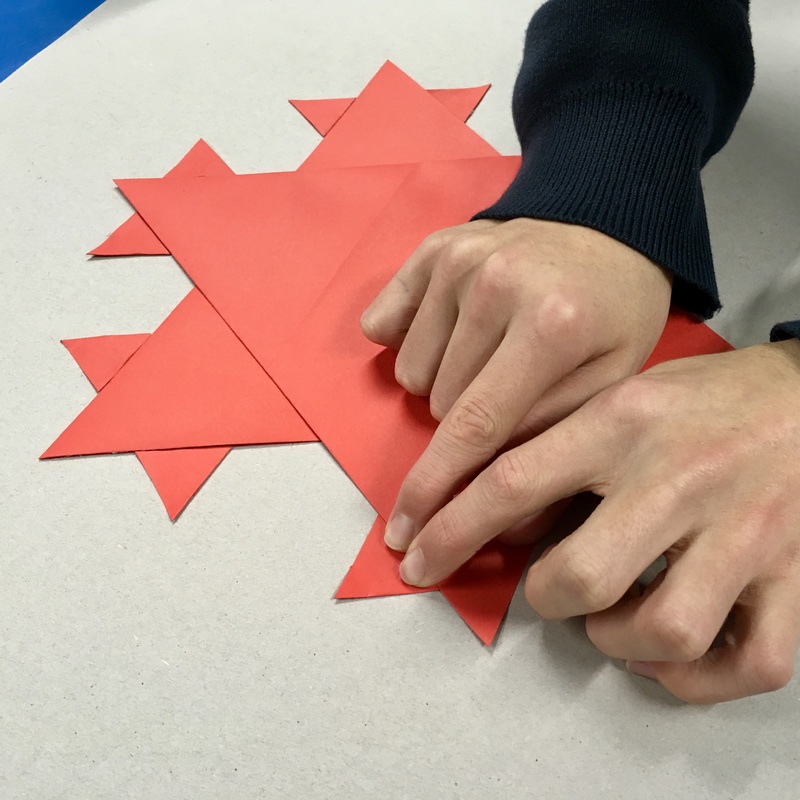
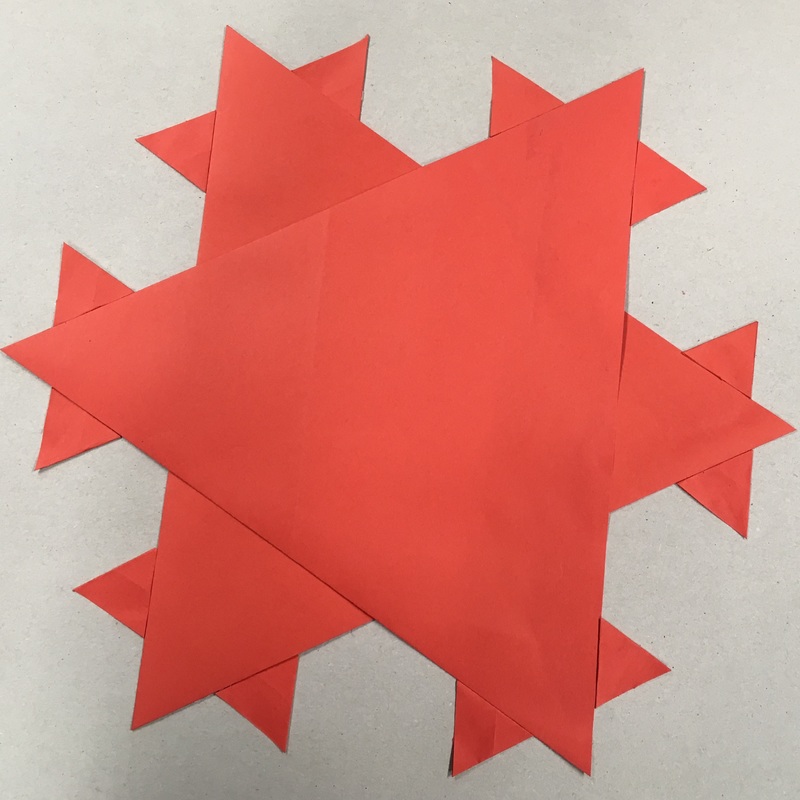
Inspiration for this activity struck whilst I was attending the recent ATM/MA 'Problem Solving with Paper Folding' course delivered by Fran Watson of @nrichmaths.  We were introduced to a very clever method for folding an equilateral triangle from A4 paper that I'd not come across before.  I'd been wanting to make Koch Snowflakes with the students, and now I had my medium! 
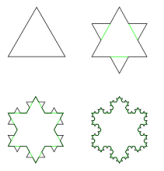
After treating the students to a 'fractal zoom' (loads available on Youtube) we looked at the Koch Snowflake in more detail, discussing its structure and how it 'grew'.  I then projected the instructions for folding the equilateral triangle (I used this resource from Arbelos; alternatively this excellent @MEImaths presentation shows it step-by-step) and let the students figure it out by themselves.  Once they'd nailed the fold, I set them the challenge of using different A-sized paper to create their own fractal snowflakes.  They did really well!
Picture
Picture
Picture
Picture
However, things got very small, very quickly.  Next time I might suggest they start with a much larger central triangle tessellated from four, or even nine, A4-sized ones, and make GIANT fractal snowflakes!
Reflecting on this activity afterwards it struck me that it had potential to form the basis of a length and area scale factors investigation.  In addition, older students could be set the challenge of calculating the (finite) overall area of the snowflake.

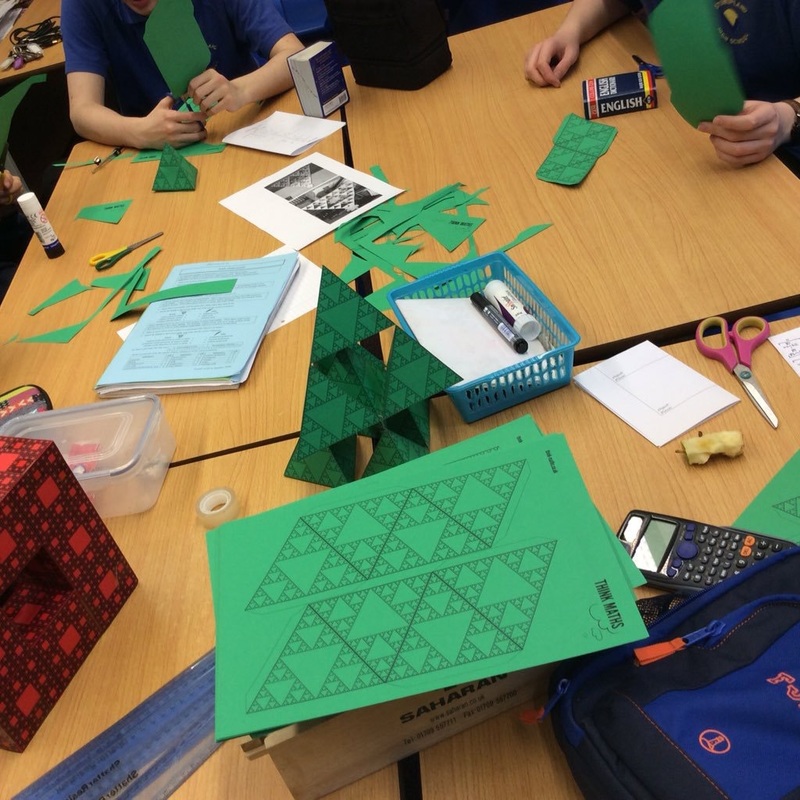
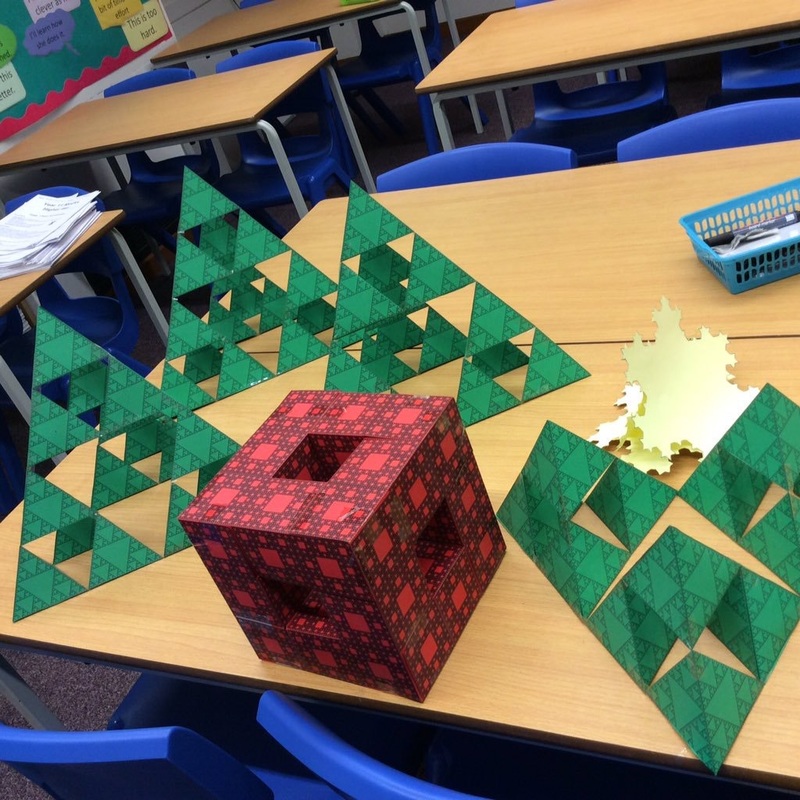
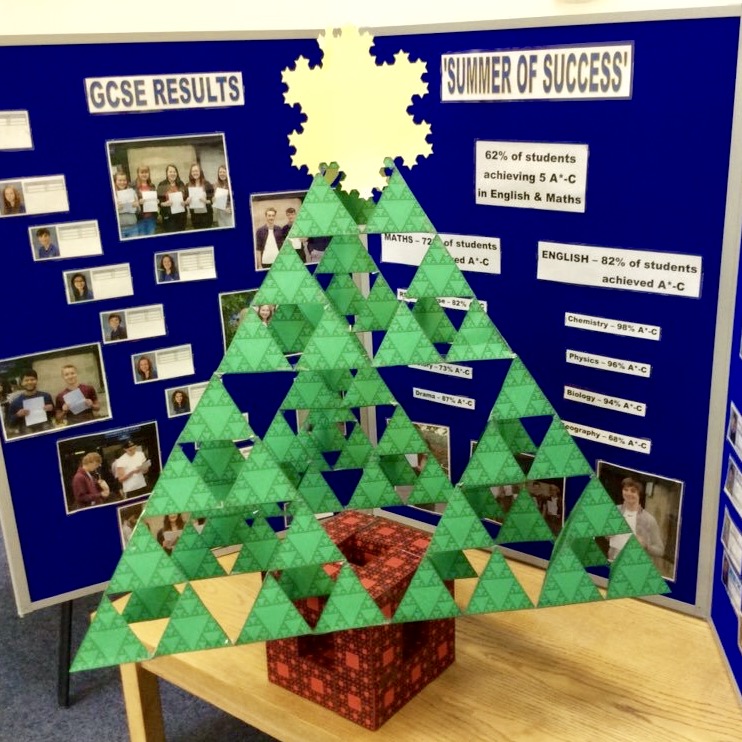
Fractal Christmas Tree

No mathematical Christmas can be considered complete without Matt Parker's (@standupmaths) ThinkMaths' Fractal Christmas tree!  This fab resource, available here, is a great test of teamwork and problem solving skills, and I was so impressed with how the students tackled it.  Deciding to call themselves 'Christmas engineers', they organised themselves into teams, set up production lines and got completely stuck into the challenge. No pics of their tree yet, but this is one I made with students last year.
Picture
Picture
Picture

Fractal Christmas Cards

We didn't have time to make these during STEM Club in the end, so I'm planning to make them with my Y12 further mathematicians after their end of term assessment instead (they are a very spoilt bunch).  Full instructions and resources are available on the Fractal Foundation website here.  Alternatively Emma Morgan (@em0rgan) has put together this useful walk-through video.
Her students' cards look fantastic!

Fractal Christmas cards! #Christmaths #maths #teaching pic.twitter.com/lER8E1ERT4

— mrs morgan maths (@em0rgan) December 15, 2015
Happy festive fractal folding :)
2 Comments
<<Previous
Forward>>

    Author

    I teach maths.  I'm a bit arty.   I like to combine the two.

    Archives

    May 2020
    December 2018
    November 2018
    August 2018
    June 2018
    December 2017
    November 2017
    February 2017
    December 2016
    November 2016
    October 2016
    September 2016
    July 2016
    June 2016

    Categories

    All
    3D
    A Level Maths
    Christmas
    Colouring
    Constructions
    Displays
    Enrichment
    Fractals
    Halloween
    Mandalas
    Mathematical Art
    Origami
    Tessellations
    Valentine's Day

    RSS Feed

    Tweets by @c0mplexnumber
Creative Commons License
This work is licensed under a Creative Commons Attribution-NonCommercial-ShareAlike 4.0 International License.
Privacy Policy
Buy me a coffeeBuy me a coffee
Terms and conditions
© COPYRIGHT 2016 CLARISSA GRANDI.  SOME RIGHTS RESERVED.